El principal problema del inversor particular, e incluso su peor enemigo, es probablemente él mismo. Las personas que no pueden controlar sus emociones no son aptas para obtener beneficios mediante la inversión.
El mercado no es eficiente, existen discrepancias entre valor y precio y lo que casi siempre está en juego es la emoción del sujeto, principalmente en el corto plazo, que oscila entre un optimismo insostenible y un pesimismo injustificado.
Al especular en vez de invertir, usted reduce las probabilidades de incrementar su propio patrimonio, y incrementa el patrimonio de algún otro.
Se debe aspirar uno resultados adecuados, no unos resultados extraordinarios…
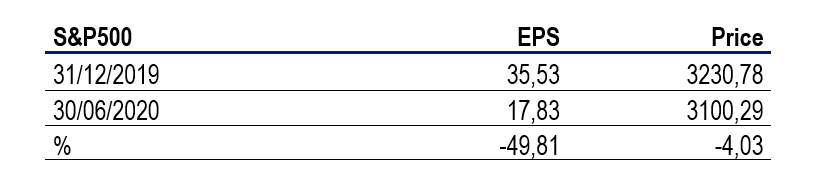
Una cartera planificada a un retorno anual de 5% y con un margen de seguridad de 25% sobre el valor del capital invertido, en función de los objetivos y restricciones del inversor se aplica una estrategia de descuento del margen de seguridad. Con la evaluación y la medición de dicha cartera se observa que al ser descontado el margen se replanifica la cartera. Por consiguiente, 71% de rendimiento.
The market efficiency
The main problem of the private investor, and even his worst enemy, is probably himself. People who cannot control their emotions are not suitable to obtain profits through investment.
The market is not efficient, there are discrepancies between value and price and what is almost always at stake is the emotion of the subject, mainly in the short term, which oscillates between unsustainable optimism and unjustified pessimism.
By speculating instead of investing, you reduce the chances of increasing your own wealth, and increase someone else’s wealth.
Adequate results should be aspired to, not extraordinary results…
A portfolio planned at an annual return of 5% and with a safety margin of 25% on the value of the invested capital, depending on the objectives and restrictions of the investor, a strategy of discounting the safety margin is applied. The evaluation and measurement of this portfolio shows that when the margin is discounted, the portfolio is re-planned. Consequently, 71% return.
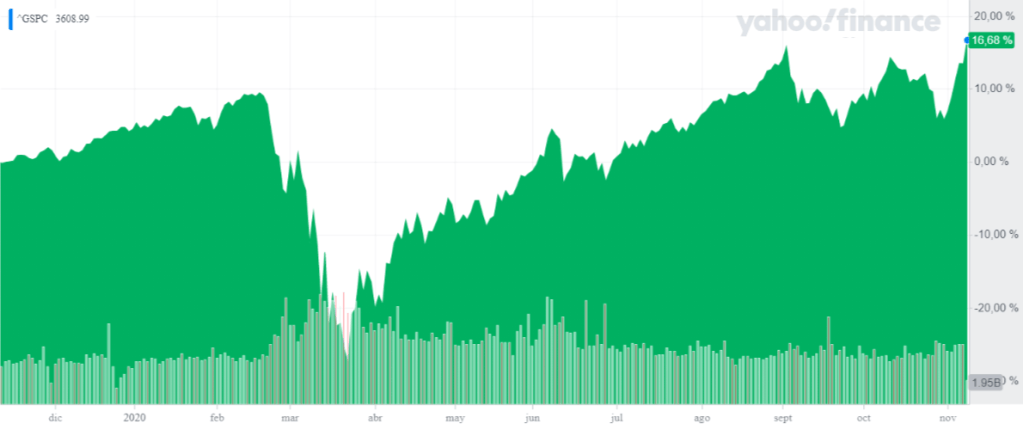
Con las circunstancias excepcionales del 2019-2020, surgieron inúmeras oportunidades para el inversor particular. Por más irracional que pueda parecer el mercado a corto plazo, siempre una planificación bien estructurada, con objetivos y restricciones sensatamente formuladas se puede lograr un rendimiento adecuado y la protección del mismo .
Nota: Índice S&P 500 – 1 Yr net change. Fuente: Yahoo Finance
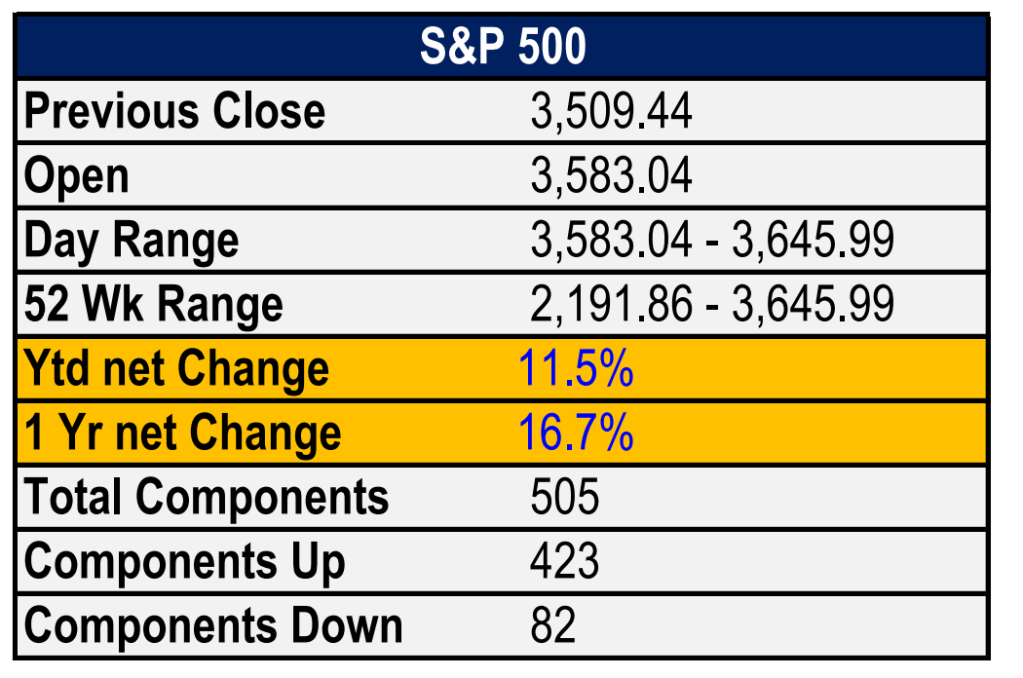
El haber estado fuera del mercado, deja el inversor totalmente desprotegido contra la inflación. El coste de oportunidad en lo que va de año hasta el día 9 de noviembre de 2020 es de un 11,5%. Por consiguiente, añadimos el promedio de inflación buscado por la Reserva Federal de los Estados Unidos de 2%. El inversor particular dejó de incrementar su capital en 11,5% y además su poder adquisitivo desciende en un 2%.
Nota: Información referente al índice S&P 500. Fuente: Barron’s
La rentabilidad aún aumenta si utilizamos la revalorización anual: 16,7%.
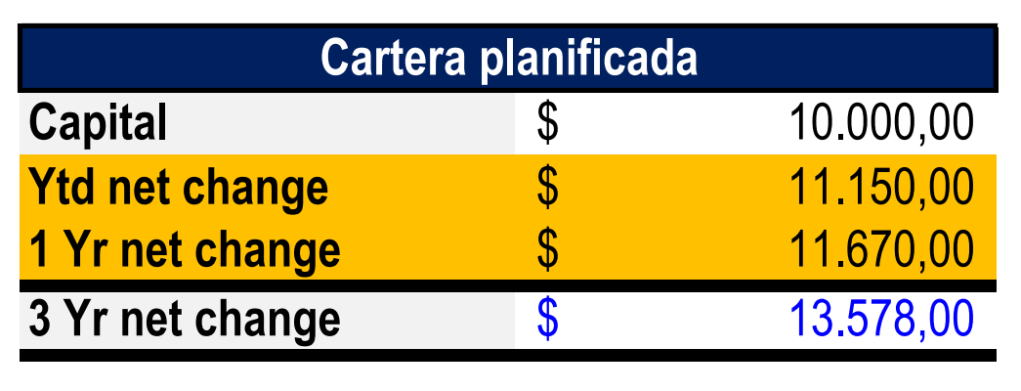
Nota: Cartera planificada hacia las expectativas del mercado, 13/11/2017 – 09/11/2020.
El inversor particular que hizo una planificación en su cartera hacia las expectativas del mercado el día 13 de noviembre de 2017, tiene una revalorización de 35,78% de su capital.
En resumen, por mas excepcional que sea la situación, lo mas sensato es no estar fuera del mercado, siempre habrá pesimistas a quien comprar y optimistas a quien vender.
The importance of not being out of the market
With the exceptional circumstances of 2019-2020, countless opportunities arose for the individual investor. No matter how irrational the market may seem in the short term, always well-structured planning with sensibly formulated objectives and constraints can achieve an adequate return and protection of the market.
Nota: Índice S&P 500 – 1 Yr net change. Fuente: Yahoo Finance
Being out of the market leaves the investor totally unprotected against inflation. The opportunity cost so far this year until November 9, 2020 is 11.5%. Consequently, we add the average inflation target of the US Federal Reserve of 2%. The private investor stopped increasing his capital by 11.5% and in addition his purchasing power fell by 2%.
Note: Information regarding the S&P 500
The profitability still increases if we use the annual revaluation: 16.7%.
Note: Portfolio planned towards market expectations, 11/13/2017 – 11/09/2020
The private investor who made a planning in his portfolio towards the market expectations on November 13, 2017, has a revaluation of 35.78% of its capital.
In short, no matter how exceptional the situation, the most sensible thing is not to be out of the market, there will always be pessimists to buy from and optimists to sell to.
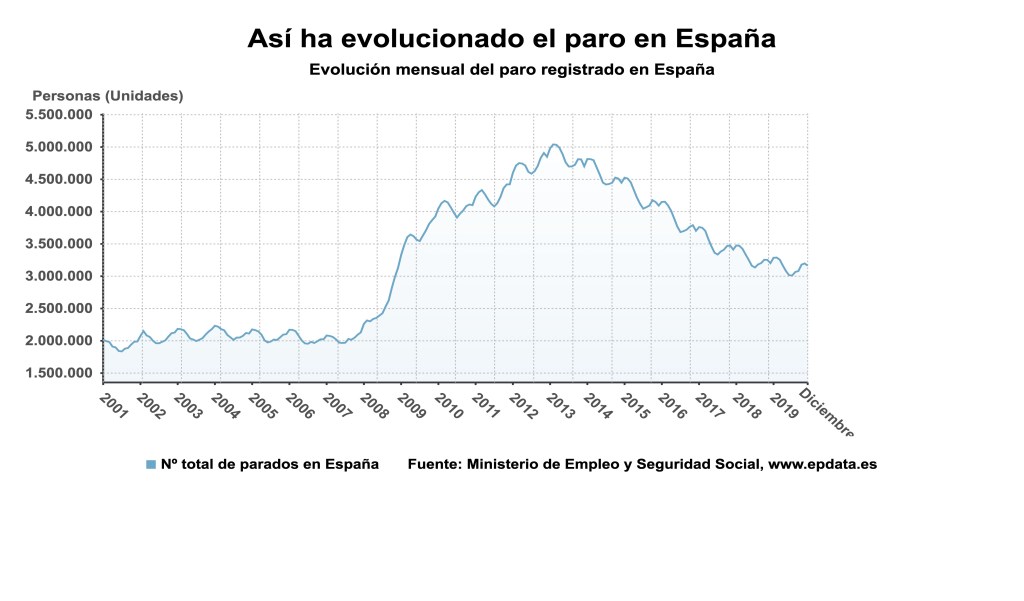
“El paro bajó en 112.400 personas en 2019, lo que supone un 3,4% menos que en 2018, registrando su séptimo descenso anual consecutivo. No obstante, este retroceso es inferior a los experimentados en los cinco años anteriores, aunque superior al de 2013, cuando el desempleo bajó en 85.400 personas. En comparación con 2018, el paro bajó en 2019 cuatro veces menos. El número total de parados cerró el ejercicio en 3.191.900 personas, el menor dato en un cierre de año desde 2007.” (Garcia, 2020).
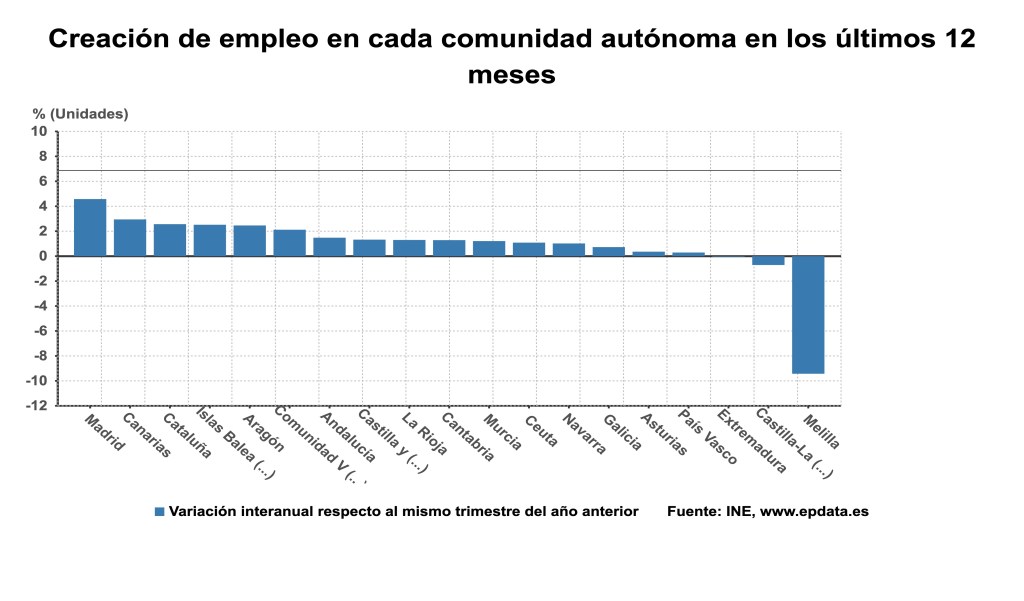
“Aunque España sí creó empleo este 2019 por sexto año consecutivo tras seis años destruyéndolo. Sin embargo, esta creación se ha frenado ya que el año pasado se generaron 402.300 puestos de trabajo, con un ritmo de crecimiento anual del 2,06%, inferior al de un año antes y la cifra más baja desde 2014. El número de ocupados creció en 92.600 en el cuarto trimestre de 2019 (se trata de su mayor aumento en un cuarto trimestre desde 2006). El total de cotizantes se situó en los 19.966.900, la mayor cifra desde el cuarto trimestre de 2008.” (Garcia, 2020).
“Por su parte, el número de activos aumentó en 290.000 personas en 2019, un 1,3% respecto a 2018, con lo que la población activa en España quedó constituida por 23.158.800 personas, de las que 19,96 millones estaban ocupadas y 3,19 millones en paro.” (Garcia, 2020).
El descenso del 3,4% del paro ya es una señal positiva hacia la economía, se reduce el gasto publico y se incrementa las recaudaciones por cotizaciones a la Seguridad Social, IRPF y por IVA, favoreciendo a todos, de forma mutua, bienestar y consumo.
La ralentización en la creación de empleo es reflejo del notable incremento en el SMI que por consiguiente se incrementó por encima del aumento en la productividad, lo que supone un mayor gasto hacia las empresas y menor producción, si producimos menos bienes, podremos satisfacer menos necesidades.
Las empresas que no pueden soportar un mayor gasto, disminuyen el factor trabajo, lo que resta a la economía el combustible de su evolución, el consumo.
monthly evolution of unemployment in Spain:
Job creation in each autonomous community in the last 12 months:
Spain creates jobs in 2019 but at a slower pace: unemployment falls by 112,400 people and 402,300 jobs are created, the lowest figure since 2014
«Unemployment fell by 112,400 people in 2019, 3.4% less than in 2018, recording its seventh consecutive annual decline. However, this decline is less than those experienced in the previous five years, but more than in 2013, when unemployment fell by 85,400 people. Compared to 2018, unemployment fell by four times less in 2019. The total number of unemployed closed the year at 3,191,900 people, the lowest figure for a year-end since 2007». (Garcia, 2020).
«Although Spain did create jobs this 2019 for the sixth consecutive year after six years of destroying them. However, this creation has slowed down since last year 402,300 jobs were generated, with an annual growth rate of 2.06%, lower than a year earlier and the lowest figure since 2014. The number of people employed grew by 92,600 in the fourth quarter of 2019 (this is the largest increase in a fourth quarter since 2006). The total number of contributors stood at 19,966,900, the highest figure since the fourth quarter of 2008». (Garcia, 2020).
«For its part, the number of active people increased by 290,000 in 2019, 1.3% compared to 2018, bringing the active population in Spain to 23,158,800 people, of whom 19.96 million were employed and 3.19 million were unemployed. (Garcia, 2020).
The 3.4% drop in unemployment is already a positive sign for the economy, reducing public spending and increasing collections of social security contributions, personal income tax and VAT, benefiting everyone in a mutual way, welfare and consumption.
The slowdown in job creation is a reflection of the notable increase in the SMI which consequently rose above the increase in productivity, which means more spending on companies and less production, if we produce fewer goods, we will be able to satisfy fewer needs.
Companies that cannot afford to spend more, decrease the labour factor, which takes away the fuel of their evolution, consumption, from the economy.
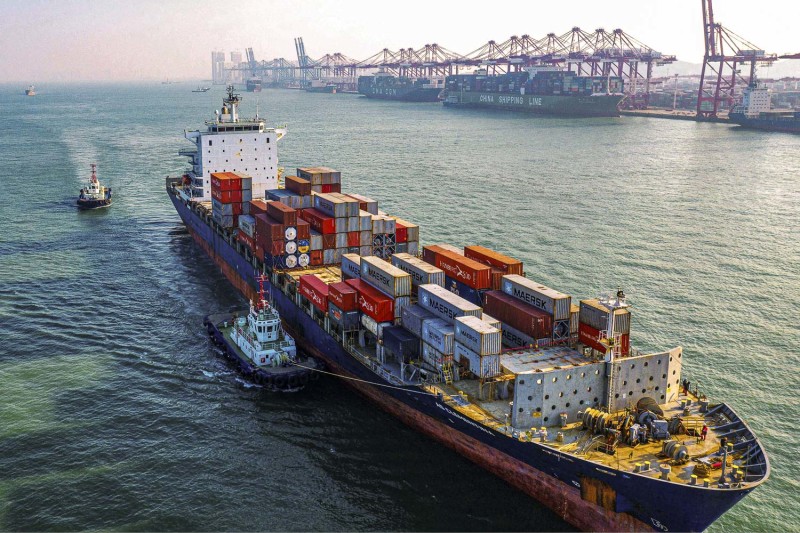
“El acuerdo comercial de primera fase firmado entre Estados Unidos y China la semana pasada tendrá un «significativo impacto negativo» en las exportaciones de la Unión Europea al gigante asiático, que recortará en unos 11.000 millones de dólares (9.912 millones de euros) sus compras a la UE en 2021, según un estudio elaborado por el Instituto para la Economía Mundial de Kiel (IfW).” (elEconomista, 2020).
«Según los cálculos, las exportaciones de la UE a China probablemente serán 10.800 millones de dólares más bajas en 2021 en comparación con un escenario en el que el acuerdo y la guerra comercial entre China y EEUU no hubieran existido», calculan los autores del estudio, señalando que la UE tendría que soportar «aproximadamente una sexta parte del desvío comercial general causado por el acuerdo.” (elEconomista, 2020)
Con dicha política proteccionista vemos como se genera ineficiencias en la economía, el productor nacional aprovecha dicho regimen de protección que le enriquece artificialmente, reduciendo la competitividad y uno de los mayores peligros en la economía es el mantenimiento a largo plazo de dicha política, por impedir el surgimiento de industrias robustas por el simple motivo de hacerlas dependientes del estado.
Existe una naturaleza de la economía, que regula y mantiene un orden en la misma y para que la economía sea próspera, hemos de respetar dicho orden y sus reglas, y el papel que juega el estado en la economía es como “parasito” de la misma y la principal característica del modelo es que el estado ha de dar libertad a los ciudadanos para producir y comerciar.
Las industrias afectadas se localizan principalmente en Alemania, pero Francia también se ha visto afectada considerablemente, siendo los mayores perdedores en la UE los fabricantes de aviones, con la pérdida de 3.700 millones de dólares (3.334 millones de euros), una caída del 28% de sus exportaciones a China, y fabricantes automóviles, con la pérdida de 2.400 millones de dólares (2.162 millones de euros), un descenso del 7% de sus exportaciones a China.
Con un total de 35% a menos de exportaciones a China se puede esperar un exceso de oferta en dichos sectores, desplomando los precios por falta de demanda y conllevar a una ralentización en la creación de empleo.
Los consumidores del gigante asiático tendrán una menor cantidad de productos importados a su disposición, lo que conlleva a una escasez y menor cuantía de satisfacción de necesidades y por consiguiente subida de precios.
The US-China trade agreement will cost the EU almost $10 billion
«The first-phase trade agreement signed between the United States and China last week will have a ‘significant negative impact’ on EU exports to the Asian giant, which will cut its purchases from the EU by some $11 billion (9.912 billion euros) by 2021, according to a study by the Institute for the World Economy in Kiel (IfW).» (theEconomist, 2020).
«EU exports to China are likely to be $10.8 billion lower in 2021 compared to a scenario where the agreement and the US-China trade war would not have existed,» the study’s authors estimate, noting that the EU would have to bear «about one-sixth of the overall trade diversion caused by the agreement. (theEconomist, 2020)
With such a protectionist policy we see how inefficiencies are generated in the economy, the national producer takes advantage of such a protection regime that enriches him artificially, reducing competitiveness and one of the greatest dangers in the economy is the long-term maintenance of such a policy, by preventing the emergence of robust industries for the simple reason of making them dependent on the state.
There is a nature of the economy, which regulates and maintains an order in it and for the economy to be prosperous, we have to respect this order and its rules, and the role that the state plays in the economy is as a «parasite» of it and the main characteristic of the model is that the state has to give freedom to the citizens to produce and trade.
The industries affected are mainly located in Germany, but France has also been considerably affected, with the biggest losers in the EU being aircraft manufacturers, with the loss of 3.7 billion dollars (3.334 billion euros), a fall of 28% in their exports to China, and car manufacturers, with the loss of 2.4 billion dollars (2.162 billion euros), a fall of 7% in their exports to China.
With a total of 35% to less than exports to China one can expect an excess supply in these sectors, driving prices down due to lack of demand and leading to a slowdown in job creation.
Consumers in the Asian giant will have fewer imported products at their disposal, leading to shortages and less satisfaction of needs and consequently higher prices.
“El Fondo Monetario Internacional ha presentado en Davos, Suiza, la actualización de sus Perspectivas Económicas Mundiales (WEO, por su siglas en inglés). Un documento que lleva por título «¿Tenue estabilización, lenta recuperación?» y en el que España no sale especialmente beneficiada ya que en los últimos tres meses ha visto como la institución capitaneada por Kristalina Georgieva ha rebajado en dos décimas sus proyecciones de crecimiento, la mayor rebaja de los países desarrollados.” (Haro, 2020).
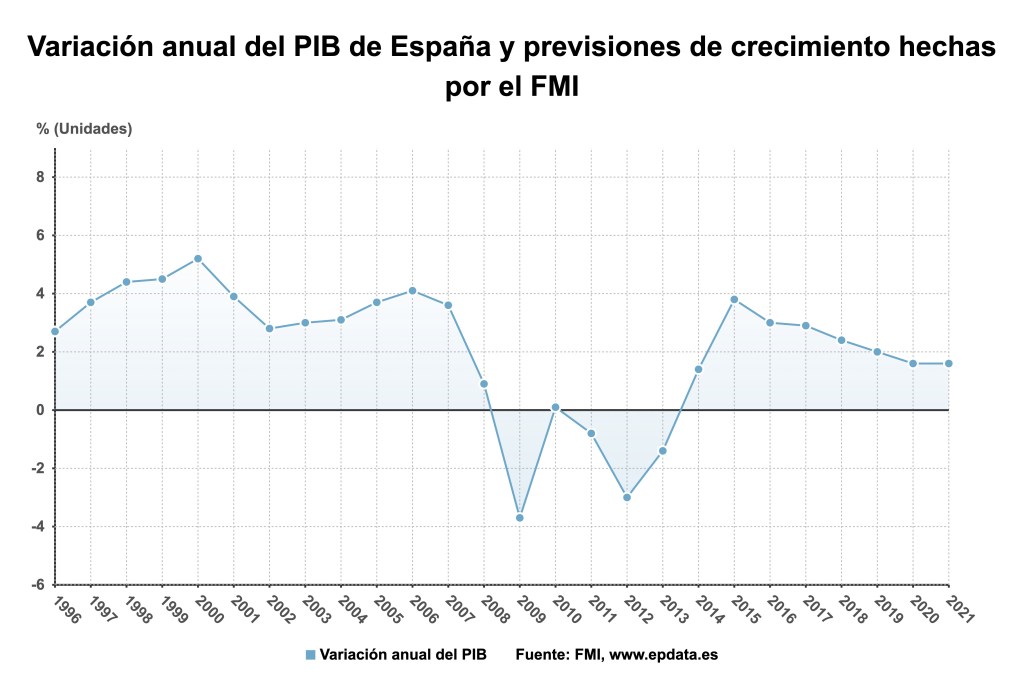
«Una expansión que este año se ralentizará hasta el 1,6%, un nivel donde se mantendrá también en 2021, un 0,1 punto porcentual menos que lo estimado a mediados de octubre, cuando el Fondo celebró su reunión anual en Washington. El informe justifica su recorte aludiendo a las secuelas de una desaceleración más marcada de lo previsto de la demanda interna y de las exportaciones en 2019.” (Haro, 2020)
La debilidad en el crecimiento está impulsada por un fuerte deterioro en la actividad manufacturera y comercio mundial, con aranceles más altos y una incertidumbre prolongada en la política comercial que daña la inversión y la demanda de bienes.
Como ya comentado en El Baron Capitalista, hay que continuar abordando la dualidad del mercado laboral, fortalecer las políticas activas, mejorar los incentivos para una mayor movilidad laboral en todas las regiones y garantizar la flexibilidad salarial y ademas, los aumentos salariales deben estar alineados con el crecimiento de la productividad para no ralentizar la creación de empleo y empeorar aun mas la perspectiva futura de la economía española.
Con los aranceles de USA hacia los productos alimentarios españoles, en especial al aceite, el vino y el queso, van a provocar un aumento de las existencias y caídas de los precios, lo que es una alerta de la pérdida de cuota de mercado y de empleo.
Las tensiones comerciales y geopolíticas, incluido el Brexit, podrían perturbar aún más la actividad económica y descarrilar una recuperación ya frágil.
The IMF cuts Spain’s growth to 1.6% in 2020 after the «marked» slowdown in demand and exports
«The International Monetary Fund presented in Davos, Switzerland, the update of its World Economic Outlook (WEO). The document is entitled «Stabilization, slow recovery» and Spain is not particularly benefited by it, since in the last three months it has seen the institution led by Kristalina Georgieva reduce its growth projections by two tenths, the largest reduction of the developed countries». (Haro, 2020).
«An expansion that will slow down this year to 1.6%, a level where it will also be maintained in 2021, 0.1 percentage point less than estimated in mid-October, when the Fund held its annual meeting in Washington. The report justifies its cut by referring to the consequences of a sharper than expected slowdown in domestic demand and exports in 2019». (Haro, 2020)
The weakness in growth is driven by a sharp deterioration in global manufacturing and trade activity, with higher tariffs and prolonged trade policy uncertainty damaging investment and demand for goods.
As discussed in El Baron Capitalista, the duality of the labour market must continue to be addressed, active policies must be strengthened, incentives for greater labour mobility must be improved in all regions and wage flexibility must be guaranteed, and wage increases must be aligned with productivity growth so as not to slow down job creation and further worsen the future outlook for the Spanish economy.
With US tariffs on Spanish food products, especially oil, wine and cheese, they will lead to increased stocks and falling prices, which is a warning of the loss of market share and employment.
Trade and geopolitical tensions, including Brexit, could further disrupt economic activity and derail an already fragile recovery.
Annual change in Spain’s GDP and growth forecasts made by the IMF.
“El Salario Mínimo Interprofesional (SMI) golpea al campo. La agricultura es uno de los sectores que más está sufriendo desde que el PSOE implantara un sueldo mínimo obligatorio de 900 euros al mes a finales de 2018, un 22% más que el anterior SMI. Hasta el propio Gobierno socialista ha reconocido los efectos perversos que el SMI ha generado tanto en la agricultura como en el empleo doméstico, cuyos profesionales cobran bajos salarios y están compuestos, principalmente, por mano de obra poco cualificada, jóvenes, extranjeros y mujeres. Precisamente, los colectivos a los que el PSOE asegura proteger.” (Garcia, 2020).
“El hasta hace unos días secretario de Estado de Seguridad Social, Octavio Granado, llegó a admitir los «problemas» que estaban surgiendo en estos sectores por el SMI, e incluso, el socialista apuntó que muchos de sus empleos se estarían trasladando a la «economía sumergida» por este salario artificial. Aún así, PSOE y Podemos continúan en su empeño de volver a elevar el Salario Mínimo a 1.000 euros en 2020 y hasta a 1.200 euros cuando acaben su primera legislatura. El campo ya no puede más y ha estallado ante una medida «inasumible para las pequeñas y medianas explotaciones», alerta el responsable del Área de Relaciones Laborales de COAG, Eduardo López.” (Garcia, 2020)
El notable incremento del SMI puede condicionar la evolución de la economía y del empleo, tanto a corto como a largo plazo, si no se sientan las bases para un crecimiento importante de la productividad, hay que hacer hincapié en la relación entre el salario mínimo y el desempleo, ya que si el SMI se incrementa por encima del aumento en la productividad, podría ralentizarse la creación de empleo, ya antes comentado en el Baron Capitalista.
El efecto ya es negativo, la afiliación en la Seguridad Social sufrió un desplome de 45.000 habitantes, restando entonces recaudaciones por cotización de la Seguridad Social, IRPF y por IVA , afecta directamente al consumo con una cifra de mas de 40 millones de Euros en saldo, a menos en la economía y todavía falta acrecentar el aumento en el gasto publico por causa de los subsidios.
Por un lado, el tener trabajadores desocupados supone una gran cantidad de factor trabajo que no se está utilizando y por tanto de bienes que no están siendo producidos, si producimos menos bienes, podremos satisfacer menos necesidades.
La subida del SMI a 1.000 euros supondría un aumento del 50,4% de los costes laborales para los agricultores, lo que resulta inasumible para las pequeñas y medias explotaciones con 2-3 trabajadores fijos, lo que conlleva a expulsarlos del mercado por la importante subida de los costes laborales o el despido de los trabajadores.
Minimum wage stifles the countryside with layoffs and mechanization: «I won’t survive».
«The Minimum Interprofessional Wage (MIS) hits the field. Agriculture is one of the sectors that is suffering the most since the PSOE introduced a compulsory minimum wage of 900 euros per month at the end of 2018, 22% more than the previous SMI. Even the Socialist Government itself has recognized the perverse effects that the SMI has generated both in agriculture and in domestic employment, whose professionals are paid low wages and are composed mainly of low-skilled labour, young people, foreigners and women. Precisely the groups that the PSOE claims to protect». (Garcia, 2020).
«Until a few days ago, the Secretary of State for Social Security, Octavio Granado, went so far as to admit the «problems» that were arising in these sectors because of the SMI. Even so, the PSOE and Podemos continue their efforts to raise the Minimum Wage to 1,000 euros in 2020 and even to 1,200 euros when they finish their first term of office. The countryside can no longer afford it and has exploded in the face of a measure that is «unbearable for small and medium-sized farms,» warns the head of COAG’s Labor Relations Department, Eduardo López. (Garcia, 2020)
The notable increase in the minimum wage can condition the evolution of the economy and employment, both in the short and long term, if the basis for significant growth in productivity is not laid, the relationship between the minimum wage and unemployment must be emphasized, since if the minimum wage increases above the increase in productivity, job creation could be slowed down, as already mentioned in the Capitalist Baron.
The effect is already negative, the affiliation in the Social Security suffered a collapse of 45,000 inhabitants, subtracting then collections of Social Security contributions, income tax and VAT, directly affecting consumption with a figure of more than 40 million Euros in balance, at least in the economy and there is still a need to increase the increase in public spending due to subsidies.
On the one hand, having unemployed workers means a large amount of unused labour and therefore goods that are not being produced, if we produce less goods, we will be able to satisfy less needs.
Raising the SMI to 1,000 euros would mean an increase of 50.4% in labour costs for farmers, which is unbearable for small and medium-sized farms with 2-3 permanent workers, which leads to their being pushed out of the market by the significant rise in labour costs or the dismissal of workers.
“Según el Fondo Monetario Internacional (FMI), la economía de esta olvidada nación sudamericana de casi 800.000 habitantes crecerá en 2020 a la espectacular tasa del 86% anual, o sea 14 veces más rápido que la economía china. Casi sobra decir que será la economía de mayor crecimiento en el mundo.” (Fajardo, 2020).
“También podría convertirse rápidamente en una de las naciones más prósperas per cápita en el hemisferio e incluso en el mundo, por cuenta del petróleo que está empezando a brotar del subsuelo guyanés.” (Fajardo, 2020).
«Eventualmente podría llegar a ser entre 700.000 y un millón barriles de petróleo diarios,» le dice a BBC Mundo Marcelo de Assis, experto de la consultora internacional en el sector petrolero Wood Mackenzie. Es el equivalente a lo que vende al exterior un exportador intermedio como Colombia, para mencionar un ejemplo.” (Fajardo 2020)
“Sin embargo, al dividirlo por el número de habitantes empieza a entenderse el efecto avasallador que puede tener en la economía de Guyana, un país 50 veces menos poblado que Colombia.” (Fajardo, 2020)
“Un reciente informe de la cadena estadounidense CNBC estimaba que Guyana podría ser el país con el mayor número de barriles de petróleo por habitante en el mundo.” (Fajardo, 2020)
Para un país con una población de menos de 800.000 personas y un PIB de poco más de 3.600 millones de dólares, el descubrimiento es un cambio de vida.
La historia contiene numerosos relatos de advertencia sobre países que han desperdiciado una súbita oleada de riqueza, un buen ejemplo es que Venezuela apostó por el petróleo en 1980, pero en 1998 el gobierno de Hugo Chávez nacionalizó la industria petrolera y comenzó a desviar los ingresos a programas sociales. El país no reinvirtió en infraestructura petrolera y cuando los precios del petróleo se desplomaron, también lo hizo la economía del país. Ahora, incluso los bienes básicos como alimentos y medicinas deben ser importados.
Además está el riesgo de padecer lo que se conoce como la «enfermedad holandesa», que pasa por el boom de las exportaciones de crudo provoque una excesiva apreciación de la moneda local y fulmine la competitividad del resto de sectores, acabando así con el tejido productivo del país.
El impacto positivo que este descubrimiento tendrá para la economía guyanesa es evidente, aunque no está exento de desafíos, dados los altos niveles de corrupción o una burocracia y clase política sin experiencia para negociaciones de este nivel.
El FMI ha estimado un crecimiento para Guyana del 28% de su PIB para 2020, un dato histórico para una economía cuyas exportaciones se basan en arroz, caña de azúcar y oro.
The South American country that is going to grow 14 times faster than China in 2020
«According to the International Monetary Fund (IMF), the economy of this forgotten South American nation of nearly 800,000 people will grow at the spectacular rate of 86% per year by 2020, or 14 times faster than the Chinese economy. It’s almost goes without saying that it will be the fastest growing economy in the world.» (Fajardo, 2020).
«It could also quickly become one of the most prosperous nations per capita in the hemisphere and even in the world on account of the oil that is beginning to flow from the Guyanese underground.» (Fajardo, 2020).
«Eventually it could be between 700,000 and a million barrels of oil a day,» Marcelo de Assis, an expert from the international oil consultant Wood Mackenzie, tells the BBC Mundo. It’s the equivalent of what an intermediate exporter like Colombia sells abroad, to name one example. (Fajardo 2020)
«However, when you divide it by the number of inhabitants you begin to understand the overwhelming effect it can have on the economy of Guyana, a country 50 times less populous than Colombia.» (Fajardo, 2020)
«A recent report by the US network CNBC estimated that Guyana could be the country with the highest number of barrels of oil per capita in the world.» (Fajardo, 2020)
For a country with a population of less than 800,000 people and a GDP of just over $3.6 billion, the discovery is life-changing.
History contains numerous cautionary tales about countries that have squandered a sudden wave of wealth. A good example is that Venezuela went for oil in 1980, but in 1998 the Hugo Chávez government nationalized the oil industry and began diverting revenue to social programs. The country did not reinvest in oil infrastructure and when oil prices collapsed, so did the country’s economy. Now, even basic goods such as food and medicine must be imported.
In addition, there is the risk of suffering what is known as the «Dutch disease», which is caused by the boom in crude oil exports, leading to an excessive appreciation of the local currency and destroying the competitiveness of the rest of the sectors, thus destroying the country’s productive fabric.
The positive impact that this discovery will have on the Guyanese economy is evident, although it is not without its challenges, given the high levels of corruption or a bureaucracy and political class without experience in negotiations at this level.
The IMF has estimated growth for Guyana of 28% of its GDP by 2020, a historic figure for an economy whose exports are based on rice, sugar cane and gold.
“El mercado de la vivienda puede ser uno de los más afectados con las nuevas normas económicas que impulsará el pacto entre PSOE y Podemos que fue presentado el pasado lunes. La redacción del documento confirmó uno de los mayores temores del sector, el control de precios del alquiler, una decisión que según promotores, socimis, propietarios y analistas perjudicará al sector.” (Fernando Cano, 2020).
“La preocupación ha ido en aumento ya que deberán asumir las propuestas más ortodoxas de Podemos y «el peor escenario posible» de los planes de la formación morada. De hecho, la realidad indica que el programa acordado con el PSOE en materia de vivienda es prácticamente idéntico al programa electoral del partido de Pablo Iglesias.” (Fernando Cano, 2020).
“El documento Coalición progresista: un nuevo acuerdo para España presenta un paquete de medidas para favorecer el acceso a la vivienda entre las que destacan la regulación de precios de alquiler, el límite a los pisos turísticos y el impulso al parque público de vivienda para alquiler social.” (Fernando Cano, 2020).
Limitar el precio de las viviendas en alquiler, lo que se conoce como controles de alquileres de primera generación, generaría efectos adversos en el mercado pudiendo provocar un exceso de demanda a la vez que desincentivaría la inversión en nuevas viviendas destinadas al arrendamiento y este tipo de medidas están penalizando a fondos, socimis y otras empresas que tienen capacidad para aumentar la oferta de viviendas en el mercado. En definitiva, las medidas van en contra de lo que intentan proteger.
Los controles de alquileres pueden reducir la movilidad de los ciudadanos y la propensión a aceptar trabajos en otras localizaciones no sujetas a control porque el inquilino es consciente de la escasez de oferta en dicha zona.
Un inquilino en una vivienda sujeta a control que es consciente de su escasez, sabe que hay una importante cantidad de personas a ocupar la suya, y que esa misma será su dificultad si la abandona.
España ha vivido una limitación en los precios del alquiler, se llamó “renta antigua” y aunque al comienzo pareció no tener impacto negativo, a medio y largo plazo destrozó el alquiler. Según pasaron los años, los propietarios, incapaces de afrontar los costes de mantenimiento de pisos cuyas rentas cada vez eran menores, dejaron de invertir y el deterioro de las viviendas traspasó a los edificios y a los barrios
El mercado del alquiler debe tener un funcionamiento libre, es decir, la oferta y la demanda tienen que fijar su nivel de precios, sobre todo porque, en este caso, el producto no es fungible, es decir, no es intercambiable y cada piso varía en ubicación, número de m2, calidades de construcción, etc.
Si al Gobierno le preocupa el alza en los precios del alquiler, debería tomar medidas de incentivo en el aumento de la oferta y no actuar en los precios.
Esta medida tendrá un efecto muy negativo en la economía, porque los propietarios, retiran sus inmuebles del mercado o bien optan por cobrar en negro parte de la renta.
El gran problema es que Podemos no cree en la propiedad privada, por lo que todos los bienes deben estar al servicio del bien común y eso es algo que destruye el mercado y nos hace caminar hacia atrás.
The future of housing after limiting the price of rent: more expensive, less supply and black money.
«The housing market may be one of the most affected by the new economic rules that will be promoted by the pact between PSOE and Podemos that was presented last Monday. The drafting of the document confirmed one of the biggest fears of the sector, the control of rental prices, a decision that according to developers, socimis, owners and analysts will harm the sector. (Fernando Cano, 2020).
«Concern has been growing as they will have to take on board the more orthodox proposals of Podemos and «the worst possible scenario» of the plans for the purple formation. In fact, the reality indicates that the program agreed with the PSOE in matters of housing is practically identical to the electoral program of the party of Pablo Iglesias». (Fernando Cano, 2020).
«The document Progressive Coalition: a new agreement for Spain presents a package of measures to favour access to housing, among which the regulation of rental prices, the limit to tourist apartments and the promotion of public housing for social renting stand out». (Fernando Cano, 2020).
Limiting the price of rental housing, known as first-generation rent controls, would generate adverse effects on the market and could lead to excess demand while discouraging investment in new housing for rent, and this type of measure is penalizing funds, companies and other companies that have the capacity to increase the supply of housing on the market. In short, the measures run counter to what they are trying to protect.
Rent controls can reduce citizens’ mobility and the propensity to take jobs in other locations not subject to control because the tenant is aware of the shortage of supply in that area.
A tenant in controlled housing who is aware of the shortage knows that there is a significant number of people to occupy his or her home, and that this will be his or her difficulty if he or she leaves.
In Spain there has already been a limitation on rental prices: it was called «renta antigua» and although at the beginning it seemed not to have a negative impact, in the medium and long term it destroyed the rent. As the years went by, the owners, unable to afford the maintenance costs of apartments whose rents were decreasing, stopped investing. The deterioration of housing transferred to buildings and neighbourhoods
The rental market must be free to operate, i.e. supply and demand must set the price level, particularly as the product is not fungible, i.e. not interchangeable, in this case. Each flat varies in location, number of square metres, construction quality, etc.
If the Government is concerned about the rise in rental prices, it should take incentive measures to increase supply and not act on prices.
This measure will have a very negative effect on the economy, because the owners either withdraw their properties from the market or choose to collect part of the rent in the black. The big problem is that We can not believe in private property, so all goods should be at the service of the common good and that is something that destroys the market and makes us walk backwards.
“El índice de precios al consumo (IPC), principal indicador de la inflación en China, aumentó un 2,9% en 2019, según datos publicados hoy por la Oficina Nacional de Estadística (ONE).” ( elEconomista, 2020).
“Siguiendo la tónica habitual de los últimos meses, los principales protagonistas de este aumento de precios fueron los alimentos, que se encarecieron un 7% a lo largo del año, y en concreto la carne de cerdo, una de las favoritas en China, que subió un 42,5% debido a que una epidemia de peste porcina africana ha diezmado la población de gorrinos.” ( elEconomista, 2020).
“Esta subida de precios y la caída de la producción debido a la enfermedad también encarecieron mucho otras carnes con las que los chinos trataron de sustituir a los productos porcinos, como la ternera (+12,1%) o el cordero (+11,9%).” ( elEconomista, 2020).
«Los datos referentes al mes de diciembre muestran que el IPC se mantuvo en máximos desde 2011 al elevarse un 4,5% -misma cifra que en noviembre- debido, como era de esperar, a los precios de los alimentos (+12,9% interanual).» ( elEconomista, 2020).
“En diciembre, la carne de cerdo fue casi el doble de cara (+97%) que en el mismo mes del año anterior.” ( elEconomista, 2020).
Los problemas provocados por la inflación se derivan precisamente de su imprevisibilidad ya que ni todos los productos ni todos los factores subirán sus precios al mismo tiempo ni en la misma proporción. Y cuanto mayor sea la tasa de inflación, más amplio será el margen de error en las expectativas de los agentes económicos y por tanto mayor la sensación de inseguridad, el empresario encontrará dificultades adicionales para prever los beneficios de su actividad debido a la inseguridad en los precios futuros de los factores, los productos intermedios y los productos finales.
El principal efecto negativo de la inflación, en una economía de mercado, es que destruye el sistema de precios de la economía.
Los precios son una vía por la que se transmite la información necesaria para que los consumidores decidan correctamente qué deben adquirir y para que las empresas calculen qué y cuánto deben producir. Si los precios están cambiando continuamente, dejan de cumplir su función informativa; los consumidores serán incapaces de saber si un supermercado tiene los precios más bajos que otro; los supermercados perderán el estímulo para mantener los precios bajos y serán incapaces de predecir los efectos sobre la demanda de una subida de los precios de mayor o menor cuantía.
Los productos que más suben en épocas de inflación son los de mayor consumo, con lo que este aumento de los precios lo sufren todos los consumidores. Como podemos suponer los productos más demandados suelen ser los de primera necesidad y en estos casos resulta más difícil prescindir de ellos. Si la comida o la ropa suben de precio las economías familiares se resienten.
Los efectos de la inflación en una economía son diversos, y pueden ser tanto positivos como negativos. Los efectos negativos de la inflación incluyen la disminución del valor real de la moneda a través del tiempo, el desaliento del ahorro y de la inversión debido a la incertidumbre sobre el valor futuro del dinero, y la escasez de bienes. Los efectos positivos incluyen el fomento de un aumento en el consumo.
Si la subida de los precios no se ve compensada por un incremento en los salarios tendremos más dificultades para llegar a fin de mes. Pero si los salarios suben se puede entrar en un círculo vicioso, ya que los empresarios para compensar este aumento venderán más caros sus productos, con lo que la inflación seguirá existiendo.
Inflation in China grew by 2.9% in 2019 due to higher food prices: pork was up 42%.
«The consumer price index (CPI), the main indicator of inflation in China, rose by 2.9% in 2019, according to data released today by the National Bureau of Statistics (NBS).» ( elEconomista, 2020).
«Following the usual trend of recent months, the main protagonists of this price increase were food, which became 7% more expensive over the year, and in particular pork, one of the favourites in China, which rose by 42.5% because an African swine fever epidemic has decimated the pig population». ( elEconomista, 2020).
«This rise in prices and the fall in production due to the disease also made other meats much more expensive with which the Chinese tried to replace pork products, such as beef (+12.1%) or lamb (+11.9%)». ( elEconomista, 2020).
«Data for December show that the CPI remained at its highest level since 2011 rising by 4.5% – the same figure as in November – due, as expected, to food prices (+12.9% year-on-year). ( elEconomista, 2020).
«In December, pork was almost twice as expensive (+97%) as in the same month last year.» ( elEconomista, 2020).
The problems caused by inflation stem precisely from its unpredictability, since not all products or all factors will increase their prices at the same time or in the same proportion. And the higher the rate of inflation, the wider the margin of error in the expectations of economic agents and therefore the greater the sense of insecurity, the entrepreneur will find it more difficult to forecast the profits of his activity due to the uncertainty in the future prices of factors, intermediate products and final products.
The main negative effect of inflation, in a market economy, is that it destroys the price system of the economy.
Prices are a way of transmitting the information necessary for consumers to decide correctly what they should buy and for companies to calculate what and how much they should produce. If prices are continually changing, they cease to fulfil their informative function; consumers will be unable to know whether one supermarket has the lowest prices or not; supermarkets will lose the incentive to keep prices low and will be unable to predict the effects on demand of a price increase of a greater or lesser amount.
The products that rise most in times of inflation are those with the highest consumption, so this price increase is felt by all consumers. As we can assume, the most demanded products are usually the basic necessities and in these cases it is more difficult to do without them. If food or clothing prices rise, family economies suffer.
The effects of inflation on an economy are diverse, and can be both positive and negative. The negative effects of inflation include the decline in the real value of the currency over time, discouragement of savings and investment due to uncertainty about the future value of money, and scarcity of goods. Positive effects include encouraging an increase in consumption.
If the rise in prices is not offset by an increase in wages, it will be more difficult to make ends meet. But if wages rise, we may enter a vicious circle, as employers will sell their products more expensively to compensate for this increase, and inflation will continue to exist.
“La Generalitat, el Ayuntamiento de Barcelona y el Àrea Metropolitana de Barcelona (AMB) han acordado un cambio de modelo tarifario en el transporte público para el 2020 que simplifica la gama de títulos e incorpora algunos nuevos.”(elPeriódico, 2019).
“Billete sencillo. Se mantiene como hasta ahora -pagas un viaje- con un incremento de precio. Precio (1 zona): sube de los 2,20 euros hasta 2,40 eu.” (elPeriódico, 2019).
“T-Casual. Sustituye a la T-10, que desaparece, por un precio más elevado y de carácter unipersonal -tan solo se puede validar una vez pero es transferible-. Esta tarjeta es para 10 viajes y se puede utilizar durate un año. [La actual T-10 será unipersonal a partir del 1 de enero y se podrá utilizar hasta el 29 de febrero]. Precio (1 zona): sube de los 10,20 euros de la T-10 hasta 11,35 eu.” (elPeriódico, 2019).
“T-Usual. Sustituye a la T-mes, que desaparece. Se trata de una tarjeta que se puede utilizar de manera ilimitada durante 30 días consecutivos. Es personalizada, por lo tanto solo la puede utilizar el titular del billete. Precio (1 zona): baja de los 54 euros de la T-mes hasta 40 eu.” (elPeriódico, 2019).
“T-Jove. Se mantiene pero baja sensiblemente su precio. Número ilimitado de viajes durante 90 días consecutivos para personas de hasta 25 años. Es personalizada. Precio (1 zona): baja de 105 euros a 80 eu.” (elPeriódico, 2019).
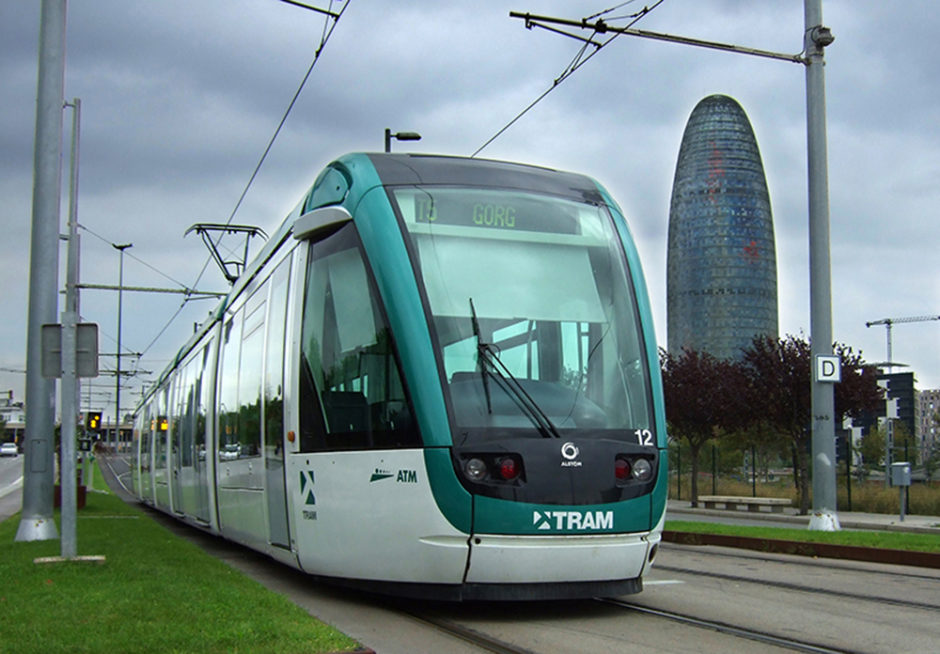
Esta nueva tarificación entra en vigor el mismo día que la Zona de Bajas Emisiones (ZBE) que prohíbe el paso por el interior de Barcelona a los vehículos más contaminantes, bajar los precios de los billetes de uso frecuente a partir de enero es una estrategia para potenciar el uso intensivo del transporte público y hacer que desplazarse diariamente en metro, autobús, tren y tranvía salga mejor de precio, cuanto más viajas, menos pagas.
El impacto hacia los estudiantes (hasta 25 años) es positivo, por el motivo de tener un abaratamiento en su transporte de 25 Euros, teniendo un ahorro de 100 Euros al año (T-Jove). Según el Ayuntamiento de Barcelona, en 2018 el título T-Jove tuvo un total de 36 millones de viajeros, área metropolitano de Barcelona, que si utilizamos como ejemplo para un pequeño análisis estaríamos hablando de 900 millones de Euros al año ahorrado por parte de los estudiantes hacia el transporte público, lo que favorece a la economía por la fomentación del consumo.
Según el Ayuntamiento de Barcelona, en 2018 el título T-mes tuvo un total de 57 millones de viajeros, área metropolitano de Barcelona, con el abaratamiento en 14 Euros del nuevo título (T – Usual), estaríamos hablando de una media de 798 millones de Euros ahorrados al año.
Las nuevas tarifas del 2020 del transporte público tiene un impacto a la par muy positivo, por un lado hace con que la economía gane dinamismo, con la fomentación del consumo y por el otro, reducir la contaminación y hacer frente a la emergencia climática.
This is how the 2020 fares for public transport in the Barcelona metropolitan area will look.
«The Generalitat, the Barcelona City Council and the Àrea Metropolitana de Barcelona (AMB) have agreed on a change in the public transport fare model for 2020 that simplifies the range of fare options and incorporates some new ones» (elPeriódico, 2019).
«Single ticket. It remains as it is – you pay for a journey – with an increase in price. Price (1 zone): increases from 2.20 euros to 2.40 eu.» (elPeriodico, 2019).
«T-Casual. Replaces the T-10, which disappears, for a higher price and of a unipersonal nature -it can only be validated once but is transferable-. This card is for 10 trips and can be used for one year. [The current T-10 will be a single person card from 1 January and can be used until 29 February]. Price (1 zone): increases from 10,20 euros for the T-10 to 11,35 eu». (elPeriodico, 2019).
«T-Usual. Replaces the T-Month, which disappears. It is a card that can be used without limit for 30 consecutive days. It is personalized, therefore it can only be used by the ticket holder. Price (1 zone): from 54 euros for the T-month to 40 euros». (elPeriodico, 2019).
«T-Jove. It is maintained, but its price drops significantly. Unlimited number of trips for 90 consecutive days for people up to 25 years old. It is personalized. Price (1 zone): low from 105 euros to 80 eu.» (elPeriodico, 2019).
This new pricing system comes into force on the same day as the Low Emission Zone (LEC), which prohibits the most polluting vehicles from passing through the interior of Barcelona. Lowering the price of frequently used tickets from January onwards is a strategy to encourage intensive use of public transport and make daily travel by metro, bus, train and tram more affordable, the more you travel, the less you pay.
The impact on students (up to 25 years of age) is positive, as their transport costs 25 Euros, with a saving of 100 Euros per year (T-Jove). According to the Barcelona City Council, in 2018 the T-Jove title had a total of 36 million passengers, Barcelona metropolitan area, that if we use as an example for a small analysis we would be talking about 900 million Euros a year saved by students towards public transport, which favours the economy by encouraging consumption.
According to the Barcelona City Council, in 2018 the T-month ticket had a total of 57 million passengers, in the metropolitan area of Barcelona, with the reduction of 14 Euros of the new ticket (T – Usual), we would be talking about an average of 798 million Euros saved per year.
The new public transport fares for 2020 have a very positive impact, on the one hand making the economy more dynamic by encouraging consumption and on the other hand reducing pollution and facing the climate emergency.